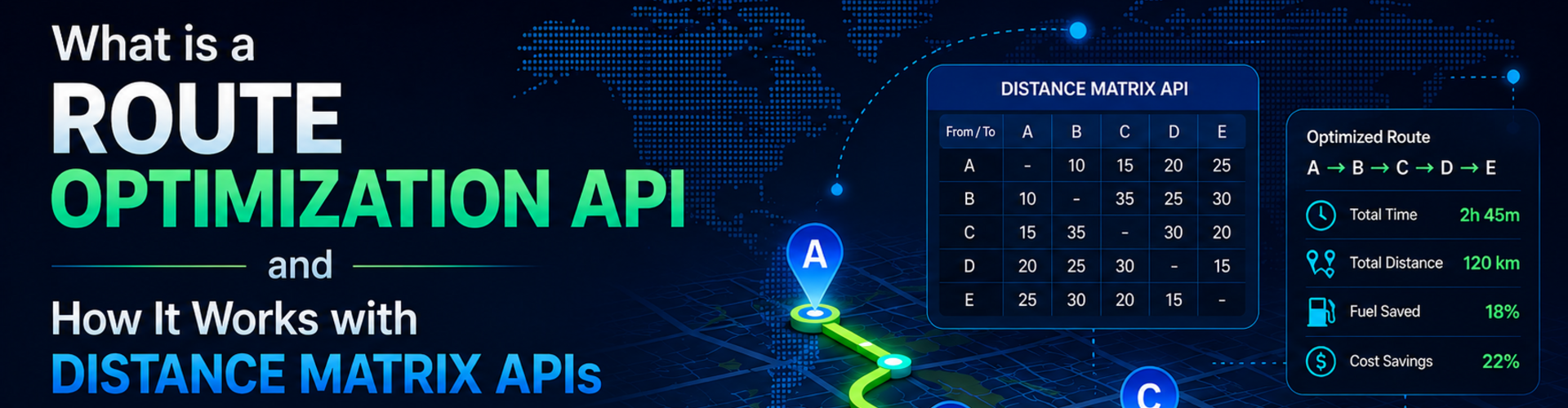
In logistics, calculating distances is straightforward, but making efficient routing decisions at scale is not.
Most systems begin with a distance matrix API such as Google’s solution. However, as operations scale, businesses start looking for a Google distance matrix API alternative that can handle large datasets more efficiently.
Because logistics is not just about measuring distance. It is about making efficient routing decisions at scale.
This is where two complementary systems come into play:
- Distance Matrix APIs - for calculating distance and travel time
- Route Optimization APIs - for planning and optimizing routes
Understanding how they work together is critical for building scalable logistics systems.
What is a Route Optimization API?
A route optimization API is designed to determine the most efficient way to complete multiple stops while considering real-world constraints.
It goes beyond distance calculation and focuses on decision-making.
It enables systems to:
- Determine the optimal sequence of stops
- Assign deliveries across multiple vehicles
- Optimize routes based on:
- Traffic conditions
- Delivery time windows
- Vehicle capacity
- Driver schedules
A route optimization API, often referred to as a delivery routing API, is built specifically to solve routing challenges rather than just calculate distances.
At its core, it solves the Vehicle Routing Problem (VRP), a widely used optimization model in logistics systems.
Simple Example
Consider:
- 10 delivery locations
- 3 vehicles
A distance matrix API will provide distances between each location.
A route optimization API will:
- Assign deliveries to vehicles
- Arrange stops in the most efficient order
- Reduce unnecessary overlap
The result is improved efficiency, reduced travel time, and better utilization of resources.
What is a Distance Matrix API?
A distance matrix API calculates the distance and travel time between multiple origin and destination points.
It answers questions like:
- What is the distance between Location A and Location B?
- How long will it take to travel between them?
However, it does not determine:
- The order of stops
- Which vehicle should take which route
- How to minimize total cost or time
It provides data, not decisions.
This is why many businesses eventually look for a Google distance matrix API alternative that supports bulk processing and scalable workflows.
Key Difference: Data vs Decision
|
Aspect |
Distance Matrix API |
Route Optimization API |
|
Purpose |
Provides distance & time data |
Provides optimized routing decisions |
|
Output |
Raw distance matrix |
Optimized route plans |
|
Routing Logic |
Not included |
Core functionality |
|
Multi-Vehicle Planning |
Not supported |
Supported |
|
Constraint Handling |
Not supported |
Supported |
In simple terms:
- A distance matrix API tells you how far locations are
- A route optimization API or delivery routing APItells you how to travel between them efficiently
The Challenge with Traditional Distance Matrix APIs
While distance matrix APIs are useful, they become difficult to scale in real-world applications.
High Number of API Calls
Large datasets require repeated requests, increasing:
- Latency
- Infrastructure load
- Cost
No Built-in Workflow
They do not provide:
- Bulk upload capabilities
- Job tracking
- Structured output handling
Limited Scalability
Managing thousands of coordinates through individual API calls becomes inefficient and complex.
Modern Approach: Bulk Distance Matrix Processing
To address these challenges, modern systems use batch-based processing models.
Instead of making repeated API calls, the workflow becomes:
- Upload a dataset (CSV format)
- Process it as a single job
- Retrieve structured results
This approach simplifies large-scale distance computation.
Modern solutions like Road Distance Calculator are built specifically for this type of high-volume processing, making them a practical Google distance matrix API alternative for businesses dealing with large datasets.
How Road Distance Calculator Fits in the Workflow
Road Distance Calculator functions as a distance computation layer within a larger routing system.
It does not replace a route optimization API or delivery routing API. Instead, it supports them.
Role in the Workflow:
- Input Preparation
Upload bulk location data using CSV formats - Distance Computation
Generate distance and duration matrices at scale - Data Output
Retrieve structured results for further use - Optimization Layer
Feed this data into a route optimization API or delivery routing API
Why This Matters
Route optimization systems depend heavily on accurate and scalable distance data.
By handling bulk computation efficiently, Road Distance Calculator:
- Reduces API overhead
- Simplifies data preparation
- Enables faster optimization workflows
Supported Input Formats
The system supports multiple input structures depending on use case:
Matrix Format (id, lat, lon)
Returns an N × N distance and duration matrix. Suitable for network analysis.
Source-Destination Format (id, slat, slon, dlat, dlon)
Returns distance and duration for each route. Suitable for direct calculations.
Tagged Format (id, lat, lon, tag)
Returns N × M matrices for source-destination grouping. Suitable for hub-based logistics.
Sample Output (Simplified)
|
Distance (km) |
Duration (seconds) |
|
41.92 |
39257.98 |
|
41.92 |
39257.98 |
|
41.92 |
39257.98 |
This structured output can be directly used in analytics systems or passed into a route optimization API for further processing.
Real-World Workflow Example
A logistics company handling thousands of daily deliveries typically follows this approach:
- Bulk location data is uploaded and processed
- Distance and duration matrices are generated
- Data is passed into a route optimization API or delivery routing API
- Optimized delivery routes are created
This combination improves operational efficiency and reduces manual effort.
Why Businesses Are Moving Beyond Basic APIs
- Last-mile delivery accounts for over 50% of logistics costs
- Inefficient routing can significantly increase fuel usage
These factors make it necessary to move beyond simple distance calculations toward systems that support optimization and scalability.
Who Should Use This Approach?
- Logistics and supply chain companies
- Fleet management platforms
- eCommerce delivery systems
- Developers building routing solutions
- Data teams working with geospatial datasets
Conclusion
Distance matrix APIs and route optimization APIs serve different but complementary purposes.
Distance matrix systems provide the foundational data required for routing decisions, while a route optimization API or delivery routing API transforms that data into efficient delivery plans.
For businesses evaluating a Google distance matrix API alternative, combining bulk distance processing tools like Road Distance Calculator with a route optimization API offers a scalable and efficient solution.
Call to Action
If your current system relies on repeated API calls for large datasets, it may be time to reconsider the approach.
Adopting a bulk processing model with tools like Road Distance Calculator, alongside a route optimization API or delivery routing API can reduce operational complexity and improve overall efficiency.